
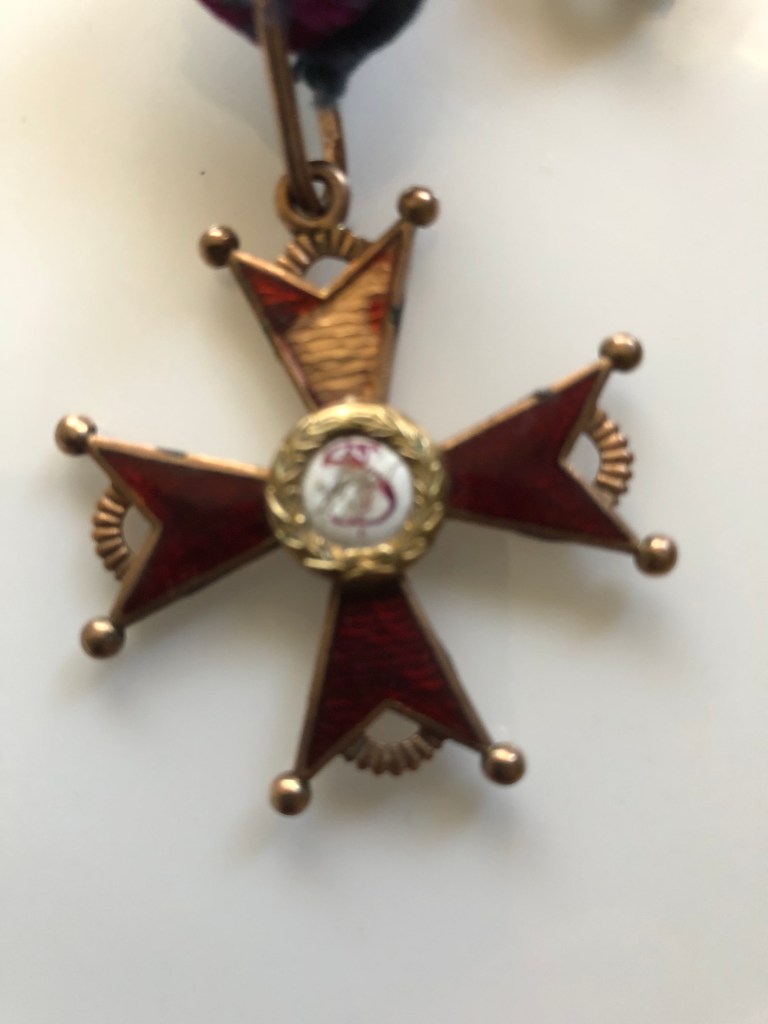
I had a conundrum with one of my ancestors’ medal. At first glance it is an inconsequential, flimsy medal; a red enameled cross with a ceramic white center with the letters SS surrounded by a gold wreath of sorts. It doesn’t resemble any known British campaign medal of the time. Plus, I hypothesized, given its lackluster and diaphanous quality, it to be an insignificant regimental honor given for a sporting competition or some leisure activity. So you can imagine my astonishment and disbelief when my friend Tejpal shared it to be the Russian Imperial medal ‘The Order of St. Stanislas’ (Orden sv. Stanislava, Орденъ Св. Станислава). A medal of great historical significance and quite a collector’s item!
Wait. What? A dynastic Russian award from the times of the Tsar/Czar! What? How did my ancestor, an Indian soldier of the British-Indian army, ever get such a decoration? In what way would he have had contact with any Russian? As the name of the ancestor is not inscribed on the medal, could it be from Babaji Sawan Singh’s 2nd Afghan war times which was fought to drive Russians out of Afghanistan? Or was it from Babaji Indar Singh’s generation when Russian empire was part of the ‘triple alliance’ on the Western Front? It so turns out that during the First World War about 350 ‘Orders of St Stanislas’ were awarded to British and Indian troops! Iain Smith, my connection from the UK based ‘Sikh Pioneers and Sikh Light Infantry Association’, stated that “at the end of the war, the Allied states made a point of making reciprocal awards of medals to their fellow Allies. You often find lists of medal awards in the London Gazette with British and Indian soldiers receiving French, Belgian, Serbian, Romanian or Russian medals. You are very lucky still to have the medal”.
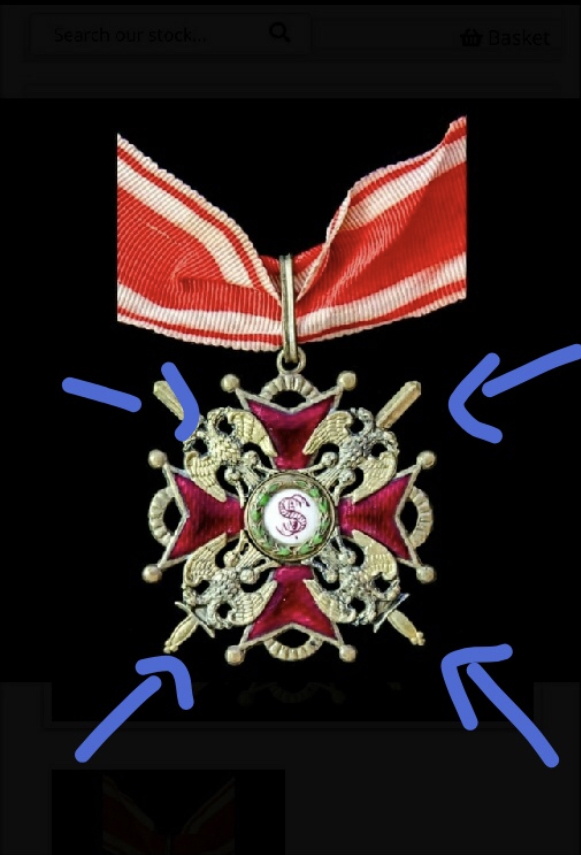
Hold on. When was the Russian Revolution? Wasn’t the Russian imperial family deposed in 1917 (while the Great war ended in 1918)? So, was this awarded under Czar Nicholas II’s reign or by the Russian provincial government that took over when the Czar abdicated? Although, getting my head around Tsar Nicholas II, ’House of Romanov’ or ‘Lenin’s Bolshevik Revolution’ was overwhelming but it really brought history to life! Now those boring and monotonous classes of world history (and historical events) had context and connection. Wow! By now you must be wondering. What is this award? From my research it appears that this royal decoration has origins in Poland where it was awarded for ‘chivalry and exemplifying christian virtues’. Then sometime in 1831, it entered the Russian honor system and was given out to both military personnel and civilians for their distinguished service. In 1844, after undergoing a few revisions and redesigns ( including splitting it into 3 classes), it started to be given out to non-christians as well. It remained in place in Russia for some time in 1917, when the ‘Provincial Government of Russia’ came into power after the abdication of the Czar. However, once the ‘Bolsheviks’ took control, all imperial and dynastic award were suspended and discontinued. The original medal as it would have been awarded to my great grandfather would have been a ‘Bath’ cross with four double-headed eagles (representing the Russian empire) with swords at each angle (all made of gold), with a circular wreath of green laurel holding the white enameled medallion with red SS in the middle. Plus, it would have been finely crafted in the workshops of highly skilled goldsmiths, silversmiths and enamelers!
In closing, although, ours is a denuded medal that is stripped of its decoration of gold crown, eagles, and swords (perhaps for its extrinsic value), it is a magnificent reminder of my ancestor’s valor, heroism, sacrifice, and for being brethren in arms in the trenches of an awful war. It tells of a tremendous story of resilience in the battlefield for which he was recognized by a foreign sovereign/government. What an exquisite and priceless piece of history which I will cherish all my life!
Other Interesting stuff –
- Our medal has a mismatched ribbon! For some reason, a family member swapped out the ribbon with the one from 1911 Delhi durbar. Hopefully, I can correct it in future once I procure the correct ribbon.
- Did you know historians did not chronicle WW1 records until 1922 (4 years after the war ended)? Therefore, they may have failed to properly document the accounts of Indian soldiers especially the ones who perished before the war records were tabulated. Thus my great grandfather’s story in an incomplete one! (Thank you Tejpal for this information
References –
http://www.theaerodrome.com/medals/russia/osts.php
http://www.worcestershireregiment.com/wr.php?main=inc/a_foreign_russian
http://nicholsonadvisory.com/imperial-royal-order-of-st-stanislas
 Erudite Kahani