
In many a culture Autumn is a time to celebrate, honor and pay homage/obeisance to ancestors who are no longer with us. They are remembered in Mesoamerica as ‘El Dia De Los Muerto (The Day of the Dead)’ , in England and Celtic cultures as ‘All Hallows Eve’ and ‘Samhain’ respectively, in Japan as ‘Bon or Obon’ festival, and in India as ‘Shraadh or Pitr Paksh’ (The fortnight of ancestors)’, etc. Now that it’s Fall again in the northern hemisphere, it’s time to remember our forebears, and I would like to salute and pay tribute to my maternal great-grandfather, Sardar Gahil Singh. I previously wrote a brief a blogpost on him on April 1, 2019, regarding his work with M.A. Macauliffe to translate the Guru Granth Sahib in English. Since then, I have had more fortuitous connections with my aunts and cousins who are also his direct descendants and I learnt so much more. I must also thank Chiraagi Gill and Deepi Brar to give concrete information and pictures, which also validates what my mother has shared with me. In addition, I also found a treasure trove of information in various British and US newspaper archives.
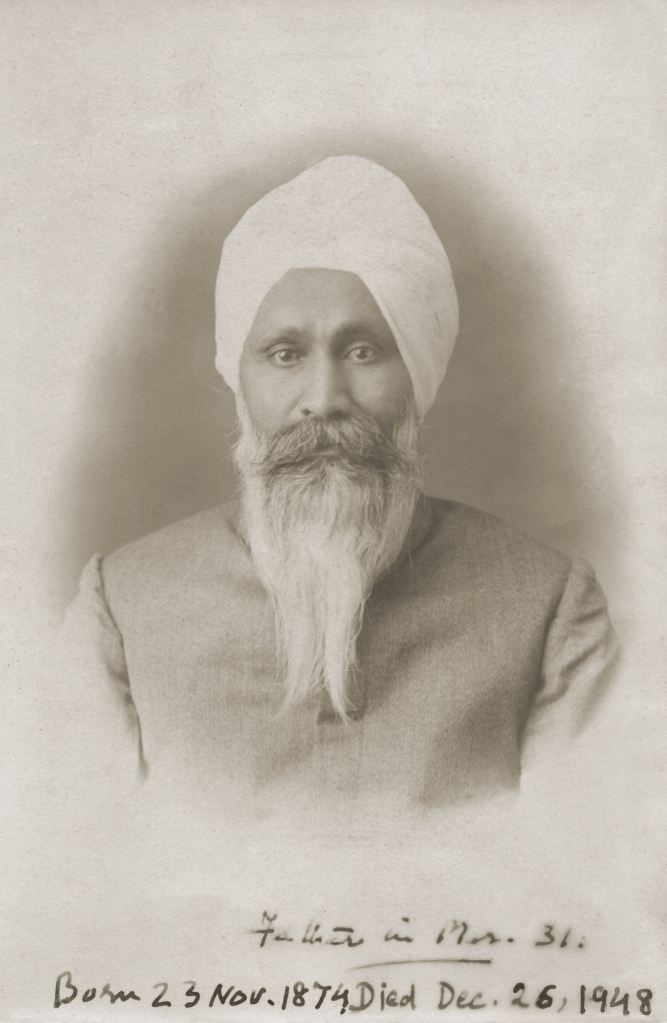
Sardar Gahil Singh Sangha was born on November 23rd, 1874. He was orphaned at a young age, remained unschooled and uneducated until the age of 11 or 12, and in those early formidable years grazed cattle or worked on the farm! It is unknown how his parents died (my mother shares that his elder sister and brother-in-law raised him, while my cousin’s share that it was his maternal uncles). Everything changed for him when he went to an ‘Adalat’ (courthouse) where he got fascinated and beguiled by the stature, eminence, and jurisdiction of the officiating judge as well as the deep reverence, admiration, and the social standing that the position held. He inquired how he could become one. Thereafter, he completely immersed himself in studies, earned a bachelor’s degree (a feat in late 19th century), and became quite a prolific scholar and learned man of his time. He became a ‘Nazim’ (a session judge) of in the Patiala principality (Narnaul-Mahendergarh) and a high official in the Ijlas-i-khas (the court of the maharaja) during the reign of Maharaja Bhupinder Singh. This is also the time when he got acquainted with M.A. Macauliffe, the then deputy commissioner of Punjab (later a divisional judge), and upon his retirement in 1893 was helped and advised by this patriarch with the translation of the sacred Sikh scripture ‘Sri Guru Granth Sahib’ into English. He did this as a ‘gupt seva’ (selfless anonymous work without the thought or need for recognition, reward). Although he kept his contribution anonymous, I think a lot of time has passed and I want the world to know of that as well and for that I have added the article below that was published on Mr. Mcauliffe’s passing and the people associated with him are listed including this patriarch.
He was married to Chand Kaur and together they had seven children – four sons and three daughters (Pratap Singh, Chitwant Kaur, Raj Kaur, Kartar Singh, Balwant Singh, Ishar Kaur, and Preetam Singh). I loved the anecdote that my cousin Chiraagi shared as to how they came to be betrothed. She shared that Chand Kaur’s father, a distinguished gentleman from Mansa, went to Khalsa College Amritsar (a very famed and eminent education institute of its time) to find an educated suiter for his daughter. Gahil Singh, was one of only two students who were still single (and not engaged to anyone), and with no parents in the picture, he was quickly roped in and betrothed! He passed away on December 26th, 1948, in his ancestral village of Talwandi Malian.
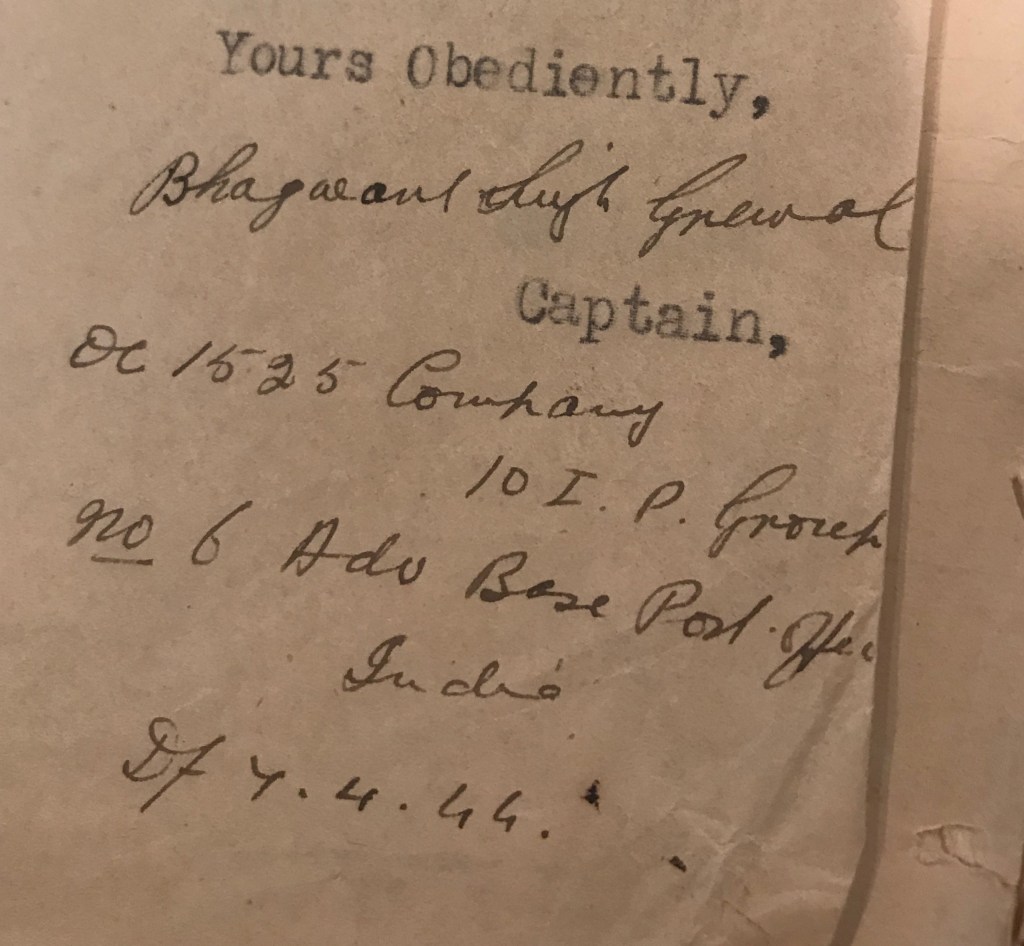
Another anecdote that my mother mentions is the circumstances in which Sardar Gahil Singh and Sardar Bhagwan Singh (Nazim of Nabha) were able to get their offsprings’ married despite intense rivalry between Patiala and Nabha principalities. In addition, Maharaja Bhupinder Singh of Patiala renowned for his charisma, flamboyance, and opulent lifestyle, also had an equally notorious reputation for womanizing, abducting women for his harem (rewarding effected families handsomely to buy silence) and for tantalizing vices. He had scores of consorts and countless concubines, and still no woman was safe around him! In this climate, this marriage between officials of the two warring states occurred. According to my mother, Patiala Maharaja (Bhupinder Singh) upon finding out of about this marriage, was furious and stated, “were my ‘Ahalkars’ (officials) dead, that this marriage alliance had to be made with someone at Nabha.” The basis of this marriage was a judgement sent by Sardar Gahil Singh representing Patiala state to Sardar Bhagwan Singh representing Nabha state. The latter impressed by Patiala Nazim’s handwriting commented “Patialawala di lakhayi bahut soni hai (Patiala judge has a very exquisite script)’. To which someone responded that the script was not his but that of his daughter’ who perhaps was home on a school break, and perhaps helping her father. He asked if a ‘Saak’ (a proposal for marriage) could be arranged between the two parties so that their children could marry. His reasoning was that if ‘padi likhi kudi au jayoogi, ta mera khandan ban jayuga’ (an educated daughter-in-law come, my family/lineage will become educated as well). The wedding between my grandparent occurred in Ludhiana, in Pathod house, and far away from the politics of the two principalities. This also talks about his tact, discretion, and the high regard he commanded.
Below article from ‘THE CIVIL & MILITARY GAZETTE’ Published Wednesday, January 7, 1914 as well as the full transcript below that shows strong association with Mr. M.A. Macauliffe
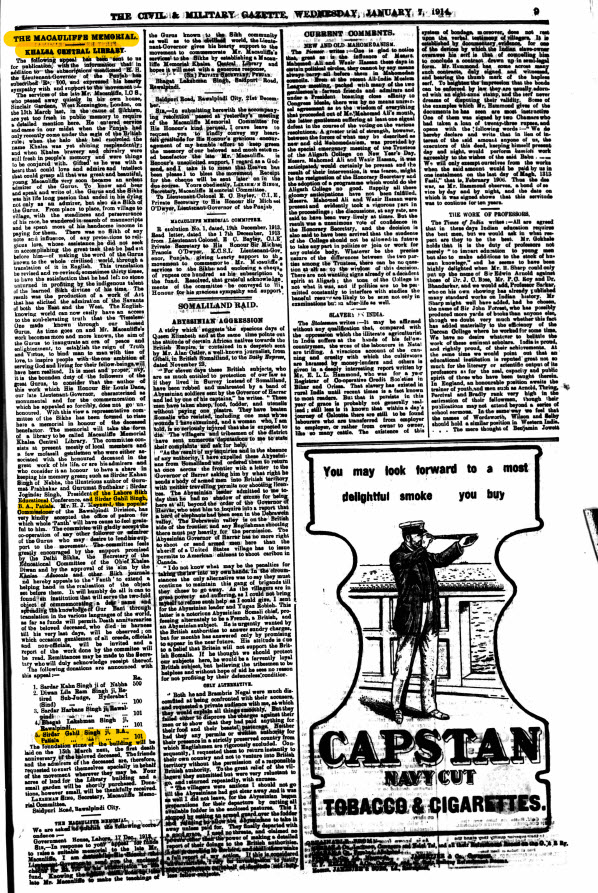
THE MACAULIFFE MEMORIAL.
——————
KHALSA CENTRAL LIBRARY.
The following appeal has been sent to us for publication, with the information that in addition to the subscriptions mentioned. H. H. the Lieutenant. Governor of the Punjab has subscribed ‘Rs. 100, and expressed his hearty sympathy with and support to the movement.
The services of the late Mr. Macauliffe, I.O.S., who passed away quietly in his own house, Sinclair Gardens. West Kensington, London, on the 15th March last, in the cause of Sikhism, are yet too fresh in public memory to require a detailed mention here. He entered service and came in our midst when the Punjab had only recently come under the aegis of the British rule; when the halo that had encircled the name Khalsa was yet shining resplendently; and when Khalsa bravery and chivalry were still fresh in people’s memory and were things to be conjured with. Gifted’ as he was with a heart that could love and admire and intellect that could grasp all that was great and beautiful, young Macauliffe very soon became an ardent admirer of the Gurus. To know and bear and speak and write of the Gurus and the Sikhs was his lifelong passion that ended in his dying not only as an admirer, but also as a Sikh of the Gurus. From place to place, from village to village, with the steadiness and perseverance of his race, he wandered in search of manuscripts, and he spent most of his handsome income in paying for them. There was no Sikh of any note and influence, of any pretentions to lore, whose assistance he did not seek in accomplishing the great task that he had set before him—of making the word of the Gurus known to the whole civilized world, through a translation of it in English. This translation he revised and re-revised, sometimes thirty times, to have the satisfaction that he had left no stone unturned in profiting by the indigenous talent at the learned Sikh divines of his time. The result was the production of a work of Art that has elicited the admiration of the Savants of both the East and the West. The English. knowing world can now easily have an access to the soul-elevating truth that the Timeless- One made known through our blessed Gurus. As time goes on and Mr. Macauliffe’s work becomes more and more known, the aim of the Gurus to inaugurate an era of peace and enlightenment, to establish the reign of Truth and Virtue, to bind man to man with ties of love, to inspire people with the one ambition of serving God and living for their fellow beings, will have been realized. It is meet and proper, nty, it is the bounden duty of the followers of the great Gurus, to consider that the author of this work which His Honour Sir Louis Dane, our late Lieutenant Governor, characterized as monumental and for the commemoration of which he appealed so forcibly, does not go unhonoured. With this view a representative committee of the Sikhs has been formed to raise here a memorial in honour of the deceased benefactor. The memorial will take the form of a library to be called Macauliffe Memorial Central Library. The committee consists at present mostly of local members and a few mofassil gentlemen who were either associated with the honoured deceased in the great work of his life, or are his admirers and who consider it an honour to have a share in keeping his memory green; such as Sirdar Kahan Singh of Nabha, the illustrious author of Gurumat Prabhakar and Gurumat Sudbakar ; Sirdar Jogindar Singh, President cf the Lahore Educational Conference, and Sirdar Gahil Singh, B. A., Patiala. Mr. H. J. Maynard, the popular Commissioner of the Rawalpindi Division, has very kindly accepted the office of patron for which whole ‘Panth’ will have cause to feel grateful to him. The committee will gladly accept – the cooperation of any other follower or admirer of the Gurus who may desire to lend His -support to the movement. The committee feels greatly encouraged by the support promised by the Delhi Sikhs, the Secretary of the Educational Committee of the Chief Khalsa Diwan and by the approval of its aim by the Khalsa Advocate and other Sikh journals and hereby appeals to the ‘Panth ‘to extend a helping hand in the realisation of the object set before them. It will humbly do all it can to found an institution that will serve the two-fold object of commemorating a della’ name and spreading the knowledge of Gur Bani through translation in the various languages of the world, as far as funds will permit. Death anniversaries of the beloved deceased, who died in harness till his very last days, will be observed; on which occasion gentlemen of all creeds, officials and non-officials, will be invited and a report of the work done by the committee will be read. Remittances may be made to the Secretary who will duly acknowledge receipt thereof. The following donations are announced with this appeal;-
The foundation stone of the building will be laid on the 15th of March next, the first death anniversary of the beloved deceased. The friends and the admirers of the deceased are, therefore, requested to exert themselves specially in behalf of the movement wherever they may be. Four acres of land for the Library building and a small garden will be shortly purchased. Donations, however small, will be thankfully received.
Rs.
1. Sardar Kahn Singh ji of Nabha … 500
2. Diwan Lila Ram Singh ji, Retired Sub-Judge, Hyderabad (Sind) 100
3. Sardar Harbans Singh ji, Rawalpindi … 100
4. Bhagat Lakshman Singh ji, … 101
5. Sirdar Gahil Singh ji, B.A., Patiala … 101
LAKSHMAN SINGH, Secretary, Macauliffe Memorial Committee,
Saidpuri Road, Rawalpindi City.











 Erudite Kahani