

There is no doubt that the current global COVID-19 health crisis is fluid, perplexing, dramatic, unsettling, paralyzing, and all-consuming; with countless images and data of people hooked up to ventilators or in body bags, healthcare workers & first responders in full PPE, (exhausted in some cases), deserted and empty streets, masked and gloved people and officials, rumors of shortages, etc., are omnipresent 24/7, in all news outlets, social media, concerned welfare calls, expert opinions and analysis, governmental or public health briefings, in unemployment numbers, in obstructed routines, etc. Although some details are useful and informational, inspiring and even funny, but mostly forbidding, confusing, and conflicting! What’s confounding is the level of disruption, uncertainty, unpredictability and paranoia that prevails. I wonder why our emotions are so heightened this time around? Doesn’t the seasonal Flu kill more people annually? What about more deadlier outbreaks like Swine Flu, SARs, MERs and Ebola, haven’t they become somewhat unmemorable & an illness of the past? It’s odd how we are indifferent and unconcerned to some maladies, yet so irrational and fearful of others? Is it because its novel (no pun intended) & unfamiliar, and we haven’t developed any coping mechanism for? Or is it more innate and is triggering our reptilian brain and our instinctive survival mechanism? Could it be even more primordial, perhaps it lays bare the cosmic truth about death, that we ultimately are not in control of how and when we die?
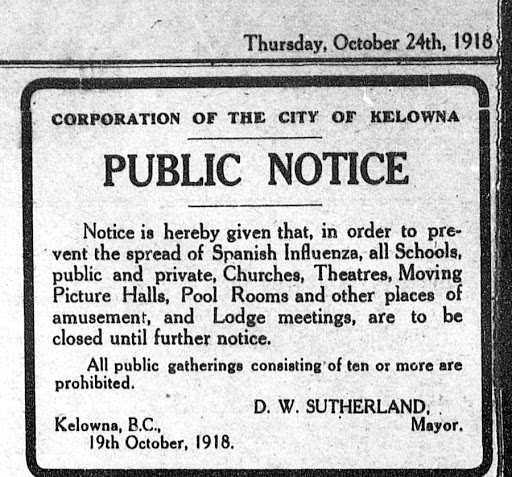
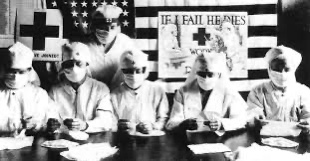
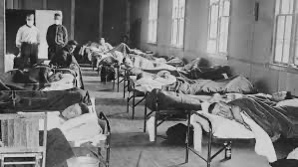
Also, what’s uncanny is the similarity that exists between ‘COVID-19’ crisis and the ‘Spanish Flu’ Influenza’ outbreak from only a 100 years back! Both respiratory diseases (one coronavirus and the other H1N1) are so analogous that barring the period attire, one can easily swap pictures, posters and advice, and in my opinion one wouldn’t even know the difference! Also, now overhearing my father, recount over the phone for his friends, the suffering from fall/autumn of 1918-19, as shared by Manji (his beloved grandmother who also lost her husband to this affliction within a short span of returning home to recuperate from the injuries to his spine that he sustained fighting in WW1), I hear him say, “Manji said there were so many deaths, when you returned from one funeral, the next funeral would be ready for cremation”. I was stunned by this revelation and the poignant, sobering and soul-stirring picture these works painted, that are also so reflective of what we are seeing with the disturbing COVID-19 scenario! Unfortunately that was the reality of the times and a common suffering, misfortune and depravity that many people and families share globally. I also noted that he called the infirmity ‘Katak di Bimari’ or ‘Illness of Katak’ (Katak, in Punjabi is the eighth month of the Desi calendar, 30 days long, with the first day falling on October 15th and the last day on November 13th), which my father later clarified that because there was absence of formal education and even lack of English language knowledge in the masses, perhaps Manji (and the locals) described this pestilence in Punjabi dialect which they were familiar & comfortable with, and one which made sense to them.
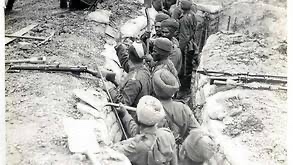

As I further my research into the perils of ‘Spanish Flu’ in India, I am finding that although it is very well pictorialized in the West, photos from Indian subcontinent was hugely lacking. This felt odd given that Indian deaths accounted for 1/5th of the 50 million deaths worldwide! Also, India had a large contingent of soldiers in WW1 and in the epicenter France where this disease broke out, what was I missing? I know experts called it the ‘forgotten pandemic’ and it certainly seemed true from the Indian experience. Also now that are read these two write-ups – 1) Arnold David’s paper titled ‘Death and the Modern Empire: The 1918-19 Influenza Epidemic in India’, where he states that “the impact of the disease was overshadowed by the prior encounter with bubonic plague, by military recruitment and the war, and by food shortages and price rises that pushed India to the brink of famine”, and 2) Angana Chakrabarti’s article “102 yrs before COVID-19, India braved The Bombay Fever pandemic that killed over 10 mn’, she calls ‘Spanish Flu’ ‘Bombay Fever’ or ‘Bombay Influenza’! I wonder if the depravations that existed in colonial India were so grave that people didn’t see ‘Spanish Flu’ as a distinctive disease and also the various colloquial names used to describe the disease takes away from knowing the true human tragedy in India? While we ponder on this, there is no doubt that Spanish Flu came to India in three waves (like the rest of the world), mainly –

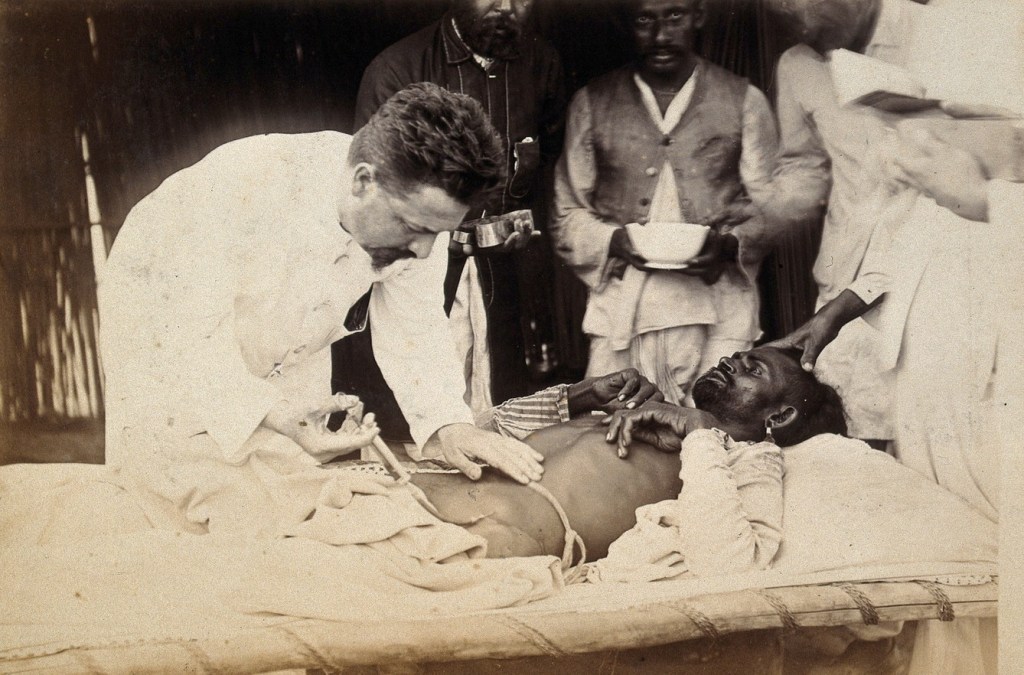

- The first wave manifested in May/June 1918 in the dock workers at the Bombay port. It lasted about 4 weeks and devastated Bombay (or Mumbai) and which the local British health officer, J.A. Turner, professed at the time “it came to Bombay like a thief in the night” (Chakrabarti, 2020). Symptoms reported were fever, bone pain, bronchial inflation, congestion, eye pains and a general feeling of malaise.
- The second wave, the most lethal & fatal, targeted young men between ages of 20 to 40 years old (of which my aforementioned great-grandfather was one of its fatalities), came to India and Punjab in September 1918 and lasted till December 1918.
- The third and final wave came in 1919.
In closing, although it’s unknown with COVID-19, what the next few days, weeks or months are going to look like, or how it may show up in history’s storyline & timeline, I am confident in the human spirit and its resilience. Also, history is witness that mankind has overcome many endemics, epidemics and pandemics, so certainly we will prevail over this too. For now, please head the warnings of the experts, wash your hands, and stay safe.
References –
- Arnold, D. (2019). ‘DEATH AND THE MODERN EMPIRE: THE 1918–19 INFLUENZA EPIDEMIC IN INDIA’. Available at: https://www.cambridge.org/core/journals/transactions-of-the-royal-historical-society/article/death-and-the-modern-empire-the-191819-influenza-epidemic-in-india/7108A9A3EC7F29ED7566C9387ED24B73 (Accessed April 4, 2020)
- https://www.livehistoryindia.com/history-daily/2020/03/24/lessons-from-the-bubonic-plague-of-1897 (Accessed April 4, 2020)
- https://digital.nls.uk/indiapapers/plague.html (Accessed April 4, 2020)
- https://punjab.global.ucsb.edu/sites/default/files/sitefiles/journals/volume20/10-Sasha%2020.pdf (Accessed April 5, 2020)
- https://wellcomecollection.org/ (Accessed April 4, 2020)
- https://www.sikhiwiki.org/index.php/Katik (Accessed April 5, 2020)
 Erudite Kahani