Mystery Of The Medal Solved…

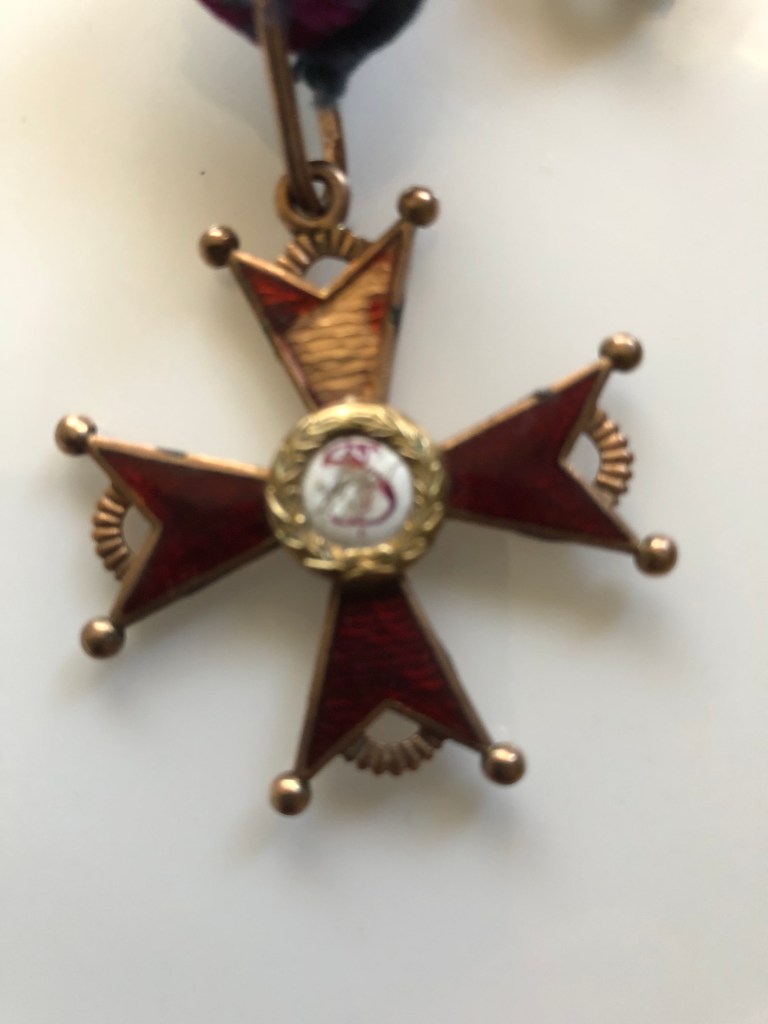
I had a conundrum with one of my ancestors’ medal.  At first glance it is an inconsequential, flimsy medal; a red enameled cross with a ceramic white center with the letters SS surrounded by a gold wreath of sorts.  It doesn’t resemble any known British campaign medal of the time.  Plus, I hypothesized, given its lackluster and diaphanous quality, it to be an insignificant regimental honor given for a sporting competition or some leisure activity.  So you can imagine my astonishment and disbelief when my friend Tejpal shared it to be the Russian Imperial medal ‘The Order of St. Stanislas’ (Orden sv. Stanislava, Орденъ Св. Станислава).  A medal of great historical significance and quite a collector’s item!  

Wait.  What? A dynastic Russian award from the times of the Tsar/Czar!  What? How did my ancestor, an Indian soldier of the British-Indian army, ever get such a decoration?  In what way would he have had contact with any Russian?  As the name of the ancestor is not inscribed on the medal, could it be from Babaji Sawan Singh’s 2nd Afghan war times which was fought to drive Russians out of Afghanistan?  Or was it from Babaji Indar Singh’s generation when Russian empire was part of the ‘triple alliance’ on the Western Front?  It so turns out that during the First World War about 350 ‘Orders of St Stanislas’ were awarded to British and Indian troops!  Iain Smith, my connection from the UK based ‘Sikh Pioneers and Sikh Light Infantry Association’, stated that “at the end of the war, the Allied states made a point of making reciprocal awards of medals to their fellow Allies. You often find lists of medal awards in the London Gazette with British and Indian soldiers receiving French, Belgian, Serbian, Romanian or Russian medals. You are very lucky still to have the medal”.
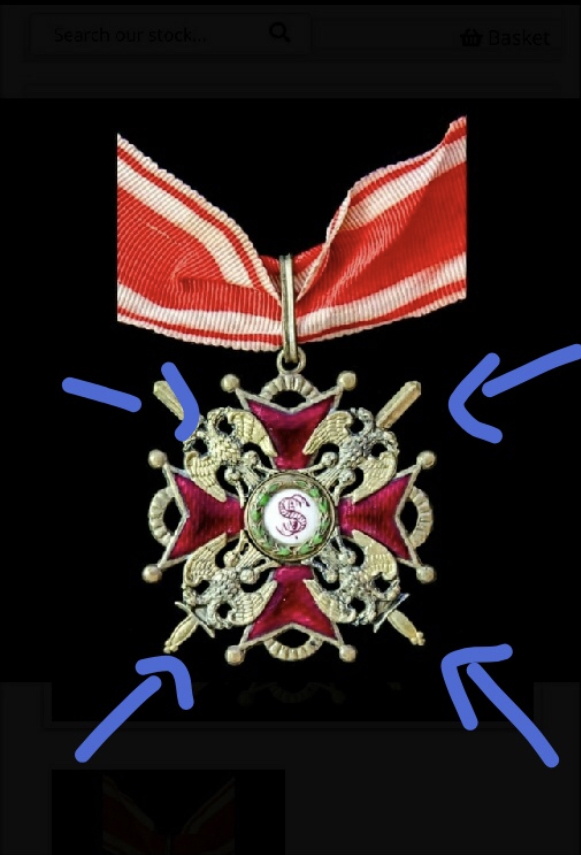
Hold on.  When was the Russian Revolution?  Wasn’t the Russian imperial family deposed in 1917 (while the Great war ended in 1918)?  So, was this awarded under Czar Nicholas II’s reign or by the Russian provincial government that took over when the Czar abdicated?  Although, getting my head around Tsar Nicholas II, ’House of Romanov’ or ‘Lenin’s Bolshevik Revolution’ was overwhelming but it really brought history to life!  Now those boring and monotonous classes of world history (and historical events) had context and connection. Wow!  By now you must be wondering.  What is this award?  From my research it appears that this royal decoration has origins in Poland where it was awarded for ‘chivalry and exemplifying christian virtues’. Then sometime in 1831, it entered the Russian honor system and was given out to both military personnel and civilians for their distinguished service.  In 1844, after undergoing a few revisions and redesigns ( including splitting it into 3 classes), it started to be given out to non-christians as well.  It remained in place in Russia for some time in 1917, when the ‘Provincial Government of Russia’ came into power after the abdication of the Czar.  However, once the ‘Bolsheviks’ took control, all imperial and dynastic award were suspended and discontinued.  The original medal as it would have been awarded to my great grandfather would have been a ‘Bath’ cross with four double-headed eagles (representing the Russian empire) with swords at each angle (all made of gold), with a circular wreath of green laurel holding the white enameled medallion with red SS in the middle.  Plus, it would have been finely crafted in the workshops of highly skilled goldsmiths, silversmiths and enamelers!  

In closing, although, ours is a denuded medal that is stripped of its decoration of gold crown, eagles, and swords (perhaps for its extrinsic value), it is a magnificent reminder of my ancestor’s valor, heroism, sacrifice, and for being brethren in arms in the trenches of an awful war.  It tells of a tremendous story of resilience in the battlefield for which he was recognized by a foreign sovereign/government.  What an exquisite and priceless piece of history which I will cherish all my life!

Other Interesting stuff –

  1. Our medal has a mismatched ribbon! For some reason, a family member swapped out the ribbon with the one from 1911 Delhi durbar.  Hopefully, I can correct it in future once I procure the correct ribbon.
  2. Did you know historians did not chronicle WW1 records until 1922 (4 years after the war ended)?  Therefore, they may have failed to properly document the accounts of Indian soldiers especially the ones who perished before the war records were tabulated.  Thus my great grandfather’s story in an incomplete one! (Thank you Tejpal for this information

References – 

http://www.theaerodrome.com/medals/russia/osts.php

http://www.worcestershireregiment.com/wr.php?main=inc/a_foreign_russian

http://nicholsonadvisory.com/imperial-royal-order-of-st-stanislas

In India’s Folk Songs, Echoes Of WW1 (WSJ Article by Karan Deep Singh)

As I am doing research on WW1 and have been able to trace my GGF Subedar Indar Singh to the western front at Festubert and Neuve Chapelle,  I came across this fascinating article Karan Deep Singh that I would like to share with you.  To access the original posting, please the click this link –  (Original articleWSJ)


In India’s Folk Songs, Echoes Of WWI

                                   — Karan Deep Singh 

A century after World War I — a conflict in which some 1.3 million Indian soldiers fought — echoes of the Great War can still be found in fading folk songs and poetry once popular in corners of rural India.

Academics have long been intrigued by the expressions of love, separation and death imbedded in Indian folklore from the time, particularly in Punjab, an area that contributed nearly half of the Indian army’s volunteer soldiers then. The songs and poems were typically sung by women.

Recently, a London-based poet Amarjit Chandan has been translating some of the works and reciting them in public addresses and performances. “Nobody ever talks about them, not to speak of singing them,” he says. He attributes that partly to a sense of shame over the fact that the soldiers had fought for the British Empire, a colonial oppressor.

Many of the songs are heart-wrenching accounts of women left behind, longing for their husbands, brothers and sons to return from “l’arme,” or  “war” in Punjabi — a word, interestingly, that was adopted widely into the Punjabi language around the time of World War I and is based on the French word for “weapon.”

Here is an excerpt from one song as translated by Mr. Chandan. The word challa would be translated as “my darling”:

Challa here comes the lorry

I carry a heavy basket on my head

I stand and wait for him on the road

With tears in my eyes

Some songs display fears among women that the British were losing the war to Germany. Rawail Singh, a professor in the Punjabi Department at Delhi University, says anti-German sentiment expressed in folk wisdom from the time likely reflects the view of Germany as evil for starting the war.

An excerpt from one such piece:

May you be defeated, O Germany

You have taken my man as a prisoner

May you be wiped out, O Germany

Who has torn the sisters apart from their brothers

The power of folk music wasn’t lost on the military. A popular song of the time, performed and recorded by Bhai Chhaila Patialewala, a famous singer then, was used in effect as an Army propaganda piece, according to Mr. Chandan. “It would have been played in village fairs and recruitment gatherings,” he says, urging the Punjabi men to join the war effort in return for benefits such as tastier food and better clothing.

Here is an excerpt as translated by Mr. Chandan. Roti refers, of course, to the flatbread:

The recruits are at your door step

Here you eat dried roti

There you’ll eat fruit

Here you are in tatters

There you’ll wear a suit

Here you wear worn out shoes

There you’ll wear boot[s]

“This song must be seen in the context of Punjab’s socioeconomic conditions at that time,” says Mr. Singh, the professor. People were poor, and the British offer of 11 rupees a month (just pennies today, but a more sizeable amount at the time) was tempting for would-be soldiers.

The Punjabi role in World War I is starting to draw wider attention today, a century after the conflict. Recently the singer Daler Kaur covered one such song, “Ve mur aa lama ton,” the title of which translates loosely as a woman calling on a loved one to return from war. It was originally sung by Surinder Kaur and written by Punjabi poet Kartar Singh Blaggan.

And the noted Punjabi playwright Atamjit (who uses one name) says he has begun research for a full-length play based on the war. The main focus, he says, will be on remembering the loss of lives as told through from the Punjabi community. “We owe a responsibility to remember. It is already too late,” he says.

The Raj, Wars and My Paternal Ancestors…


This slideshow requires JavaScript.

Last month was special.  I came across some of my ancestor’s military service documents, commendations, awards/medals, etc., for the empire days (majority of which didn’t survive partition of India and the great migration that ensued in 1947).  I was most excited about two notable documents – First, being a 130 year old enlistment certificate from the reign of Queen Victoria of my great great grandfather Sawan Singh, and second, a WW1 commendation certificate of my great grandfather Indar Singh signed by Sr. Winston Churchill (the then secretary of war). This month we also celebrate the 100th Armistice Day marking the end of World War One.

It reviewing the documents, it appears that on October 5th, 1888, my great- great- grandfather Sawan Singh enlisted in the ‘34th Sikh Pioneers’, an infantry assault regiment of the British-Indian army. I remember Manji (my great grandmother) telling us that Babaji Sawan Singh had a very long and illustrious service, that he was a Subadar-Major (which is the highest rank an Indian could attain in the Imperial armies at that time), and that he was awarded a land grant of 5 Murraba (125 Acres) in the village of ‘GB Chak No. 232’ in Lyallpur district (now in Pakistan).She also talked about all the memorabilia he brought from his various deployments, especially the Chinese storage boxes (Sandooks) and Peking Silk that had to be left behind during the hasty migration of 1947.  My research shows that some of his deployments would have been ‘relief of Chitral’ (1897), ‘Tirah Campaign’ (1897-1898), China ‘relief of Peking and Tientsin’ (1900-1901) following the boxer rebellion, etc.

Indar Singh, my great grandfather, also followed in his father’s footsteps and enlisted in the 34th Sikh Pioneers.  During the ‘Great War’ of 1914-18, his regiment (part fo the 3rd Lahore division) was first deployed on the Western Front and winning the battle honors of Festubert, St Julien, La Bassee, Armentieres, Givenchy, Neuve Chapelle, Ypres, France and Flanders, and then moved to the Middle East in the Mesopotamia Campaign where he fought against troops of the Ottoman Empire.  Manji used to mention that he showed great bravery in the battlefield, and despite being wounded himself, carried his commander to safety.  He returned home shortly thereafter as a war-casualty, and later succumbed to his injuries at home, during the month of ‘Kata’ (Punjabi month that straddles October/November), in 1918 during the deadly ‘Spanish Influenza’ outbreak.  Although Manji was pregnant with my grandfather when he passed away (so he never got to see his son).  Manji stated that he was tall (6’ 4” or 6’5″), good looking, and also a Subadar-Major like his father.  She would also talk about her wedding (she being his second wife), going to Ambala Cantt (the base of his regiment) where he was stationed as a Jamadar-Adjutant (which she pronounced Jamadar-Jitten).  She also shared of her good relations with his first wife Rattan Kaur and her stepdaughter Kamal Kaur (my father also remembers Bhauji Kamal Kaur very fondly).

Although these artifacts & stories made me aware of their rich lives and legacies, it also makes me wonder how they would have been in person.  Although history may not give them the proper dues, I for sure have a greater appreciation, respect and awe of their bravery, sacrifices, and courage.  I salute them and honor their DNA that runs thru my veins.