


This weekend my father was interviewed for the ’1947 partition archive’ by Dr. Sufyan Siddiqui and his lovely wife Lindsay Eriksson-Siddiqui. They were a delightful couple who came all the way from Denver to videotape my father’s recollections of life and events before-, during- and after- the partition of India, that saw the creation of two independent countries on religious lines (Muslim-Pakistan and Hindu-India).  This decision to split India by the British (Mountbatten), Indian National Congress leaders (Nehru, Patel) and Muslim League (Jinnah) triggered one of the bloodiest upheavals and the biggest mass-migration of humans in modern times. I characterize it as a unspoken genocide/holocaust, as growing up, it was not something that was taught in the school curriculum, one didn’t see documentaries or shows pertaining to it, not much seemed to be written about it in popular media, as a matter of fact neither did the government or national leaders talk of it. However, it was omnipresent and always in the background of the families who went thru it and was often talked about to us by our grandparents regarding how life used to be before, the people, friends, customs, what they lost, the travel to India, the hardships, etc. So, my family and I are very thankful to Sufiyan and Lindsay who volunteered their time and effort to document my father’s version of events that sheds light to a common misfortune both these countries suffered. Amazing part for me was how much my father remembered given that he was a toddler of 4 years old at the time of partition, perhaps too you to recall the events. In talking to Sufiyan & Lindsay, we realized that humans tend to remember traumatic events that they witness irrespective of age. Although I will try to post the interview if allowed, in the meantime, following is what I was able to capture of his recollections –
Pre-Partition


My father was born in the village of Chak 232 GB, Lyallpur in undivided Punjab. His family consisted on his grandmother and matriarch (Ajaib Kaur), father (Ranjit Singh), mother (Mohinder Kaur) and two younger brothers (Sukhbir and Malkiat). This village was a Sikh village, part of the canal colonies & composed mostly of ex-soldiers of the British-India armies. The family had migrated there from Jagraon when his grandfather Subedar Indar Singh of 34th Royal Sikh Pioneers was awarded 5 Murabaas or 125 acres of land (He was a veteran of WW1 who participated in the German offensive on the western front and the Ottoman empire in Mesopotamia).
He also remembered that his father bought land in the village of Chajwal (Chak 172 GB), a predominately Muslim village, where the family lived until they had to leave when it got too dangerous and unsafe for them. He vividly recalled both homes- with the house in Chak 232 being ‘Kacha’ (mud construction), whilst in Chajwal (which was newer) had a ‘pakka diwan’ (cemented formal living area) and the rest was ‘Kacha’. He remembers that the living area was elevated and away from the animal area, and they kept buffaloes for milk, oxen to plough the fields, and goat etc., at home itself. There also wan as area for grain storage at home and that they grew wheat and cotton in their farms/fields. He talked about being self-sufficient and didn’t have to buy too many things from the market including cloth/fabric (Khadar) for clothes was weaved at home by his mother and grandmother. Although he was not going to school, he remembered that the nearest school was 6 miles away in ‘Satiana Bangla’. His fondest memory seemed to be that of a gramophone that served as entertainment for the villagers, where each night, his father would put it out and the whole village gathered to listen to the old records. He remembered it to be a happy childhood where everyone supported and respected each other irrespective of their religious, political ideologies or economic status. He fondly remembers the ‘Motbar’ or headman of the village whose name he did not recall during the interview and later remembered him to be “Nur Muhammad” who considered his grandmother to be his sister. Another recollection that he remembered later on was that there was ‘Gernali road’ (or General’s road) that ran close the the village and was meant for the british, and on which he saw an occasional jeep once in a while, and was kept pristeen by a road roller. The locals were not allowed on that road so the Indians travelled on a parallel road which was not as nice (that road now seems to be called ‘Tadlianwala road’ in the current map of that area!).
His recollection of when things started to heat up was when his father returned from Lyallpur (now Faisalabad), where there was a firing and from which he saved himself by hiding under the bus. Upon his return back, he told the village elders that the tide is turning and time would come soon when they will all have to leave the village for good. The elders didn’t believe him as they considered him too young to assess the situation! It’s during this time, my father remembers going to the historical gurudwaras’ of Nankana Sahib and Panja Sahib where he recalled putting his hand in the imprint of Guru Nanak’s hand, as it was uncertain when and if they would ever return.
Partition
 He recalled that things deteriorated fast after that. He recalled the day the headman ‘Nur Muhammad’ came to Manji (his grandmother Ajaib Kaur) and said that things no longer are safe. Although he guaranteed them that none of the villagers would harm them but could not vouch for folks outside the village (which he was hearing of). Manji asked how much time would they have to pack up? He told that they just had 30 minutes, and that he will accompany them right to up to the canal and would ensure that get safely into Chak No. 232, the Sikh village. To their bad luck the wheels of the ox-cart were removed for greasing, so they could only take whatever they could grab and carry in their hands (which was not much), and that Nur Muhammed kept his word and only left when they were safely inside Chak 232.
Per my father’s recollection, the first attack on the village was by ‘Janglees’ (the local jungle folks/nomads) who came beating the ‘dhol’ (Indian drum) and were being led by a leader who was dancing on the mule. This attack was thwarted by the ex-soldiers who fired and shot the leader that scattered his followers. However, the attacks on the village kept mounting and my father clearly remembers that women were instructed to kill themselves by jumping from a tall building (and not be captured alive in case the defenses of the village fell). He also remembers his grandmother’s panic as during one of the attacks he got separated and hid, and her refusal to go into safety unless he was found! He was eventually located when the curiosity of a child got him to peek outside to see what was going on and someone spotted him. Eventually the decision was made to leave for India to Dhilwan on the river Beas.
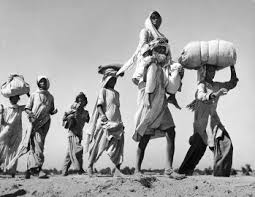 This was done in two ways, one where young women, children, elderly and handicapped went via a truck, and that is how he travelled with his mother and two younger siblings. It took them 5-6 hours to travel to East-Punjab. The route they followed was along the ‘Grand Trunk road (GT road) and went thru Lyallpur, Lahore, Amritsar, Jullundur and Beas, and my father remembers that there was excitement in the air when they reach ‘Balloke Headworks’ a dam site, on their route to India. Along the way my father remembers seeing some dead bodies, some shot, some decaying! The other was via a ‘Kafila’ (caravan) of ox-cart, horses, etc. that carried household items and that is how his grandmother and father came (they agreed to bring an ox-cart for someone provided they could also take their stuff, given they were not able to bring their ox-cart in their hurry to leave Chajwal). It took them over 3 months to reach Dhilwan given the slow nature of ox-carts to move. In the meantime, there was no news of them until one day news came that the ‘Kafila’ had reached the village and that is how they reunited as a family.
Here he also remembered an enduring memory that is etched in his brain. Apparently, to get to Dhilwan from Beas (where the truck dropped them), this stretch needed to be done on foot. However, they were told that a large Muslim Kafila has encamped on the side of the road and it would be safer if they went via the bus. My father remembers seeing this large caravan resting before it could resume its journey towards Pakistan, however, this was the monsoon period in the subcontinent with the torrential rains deluging the landscape, and as a result the Beas river started to swell. At night time, my father remembers hearing the people’s shrieks as they were being swept away by the flood waters! Another vivid story that he remembered during this time was that the floods which was chest high also caused food shortage. He remembers that one of the shopkeepers was stockpiling rice, sugar and soda (washing detergent) intended for the black market, which he refused to sell or give to these starving refugees. Only when the flood water started seeping into his storage area, he made a deal to split whatever they helped save 50/50. This is what got them thru these days where they ate raw rice mixed with sugar to survive!
Post-Partition
Once the family reunited, the arduous task of re-settlement began. The decision was made to move to the village of ‘Badhni Kalan’, which was my father’s grandmother’s parental village and where she had some land on her name. They first moved in with some of her extended family members (given she was the only child) and these relatives really welcomed them. Next came to decision to acquire their own dwelling, so it made sense when it was suggested that being refugees, they take over a house that was abandoned by a Muslim family who relocated to Pakistan. One such house was located which belonged to a teacher by the name of Sher Muhammed. Only problem was that it was being used for storage by the ‘Jan Sangh’ group, a local Hindu political party! When approached, they reluctantly agreed but told them to return the next day to get possession. However, upon their return the following day, they found that there was no one to receive them and hand them the key, instead the house was bolted shut and sealed from inside by a layer of bricks. My father recalled that then his hot-blooded uncle broke the lock, scaled the house, got inside and opened all the doors, and that is how they got possession of the house. Also, this was pre-dominantly a Hindu neighborhood so they did not want Sikhs to move in, as they thought they will be rowdy and misbehave with their women, so each night thereafter they would congregate and hold demonstrations outside their house. They even got a police constable to come each night but to the family’s good luck they had a relative at high police post in Moga (the neighboring town) so none of the police constables intruded. This was also a time when a huge tragedy and setback happened for the family. His father got admitted to the hospital due to Typhoid (apparently a doctor told them they were refugees and did not have much money, so their best bet is to go to the hospital) and during this time his one-year brother Malkiat got dysentery and he died from it. This news was kept from the father for a few days until he started to ask for him. My father recalls witnessing his grandmother crying profusely, covering her face so no one can see her grief, and took the body for burial (as infants were buried as opposed to cremation).


My father said it took them about 6 months to get used to of their new environs. He remembers fondly starting school here where first the instruction was done in Urdu and quickly changed to Gurmukhi. He remembers his teacher very fondly (although he didn’t name them all, but they were Chajju Ram who was his first grade teacher, Uttam Singh his math teacher who loved his grandmothers Dahi-Bhalla, Channan Singh, Gajjan Singh his english teacher, Mal Singh his punjabi teacher and Sant Singh his second grade teacher who was extremely near-sighted and one knew they were in trouble when he looked up from reading his book and hooked his walking stick to bring a student closer), who all although strict were excellent teachers. He proudly remembers being the monitor of his class from grade 1 to 8 and how he ran the school store, and he was loved by everyone because he was so responsible! They eventually moved to the town of Moga for higher secondary education (where the family made a house) and went on to Ludhiana for his college education. He remained a good student throughout!


He eventually joined the Indian Air Force and where he rose to the rank of Air Commodore (Brigadier General) as a navigator.
In closing, I am so proud of my father as his achievements are all his own and gained thru great hardships and perseverance. What amazes me is that he remains humble, grounded and reverent, and doesn’t let the ghosts and setbacks of the past hinder him in anyway. He is one of the most positive person I know and I am very lucky to have him in my life. I also want to take a moment to acknowledge all the families on both sides of the border who also endured and overcame such hardships. And to the citizens of both Pakistan and India who are celebrating their respective Independence days on August 14th (Pakistan) and on August 15th (India) to take the time to remember, honor and pay homage to these families and our shared history that saw 12-14 million people displaced from their homes & the refugee crisis it created, over 2 million that lost their lives, countless that became orphans or went thru great autocracies. They are our unsung heroes and we need to acknowledge that his violent partition is an important chapter of our combined histories. And for those who may have forgotten or don’t know the impact, the following youtube video captures the time and sentiments beautifully.
Other sites to explore-
https://www.facebook.com/1947PartitionArchive


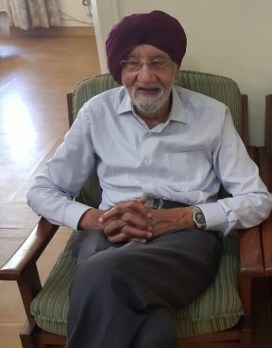 Last Sunday night came the news that Mamaji Gursharan passed away. Although this is a shocking and sad news, but knowing that he’s returned back to our maker (to a better place away from the pain and suffering of this physical plane) is comforting.


 Erudite Kahani